1. The Numbers Driving Fire Window Development
The global market for fire-rated windows keeps expanding, and the numbers tell a clear story about where investment is flowing.
| Market Segment | 2024 Value | 2032 Projection | CAGR |
|---|---|---|---|
| Fire-rated windows and doors | USD 12.5 billion | USD 23.5 billion | 7.6% |
| Metal-frame fire windows | USD 1.385 billion | USD 2.65 billion | 8.2% |
| Commercial fire windows | USD 613.58 million | USD 1.0 billion | 8.41% |
What these figures collectively indicate: demand for metal-framed fire windows is outpacing the broader fire-rated door and window market. This isn't surprising. Steel-frame fire windows are specified where failure carries the highest consequences—hospitals, high-rise residential, industrial facilities, transportation hubs.
For fire door and window manufacturers, the implication is straightforward. Growth is there, but it's concentrated in segments that demand technical sophistication.
2. Why the Frame Matters More Than People Assume
When fire resistance is discussed, glass tends to get all the attention. It's the transparent part—people see it, they ask questions about it, specifiers write detailed requirements for it.
But in a real fire, the frame carries the load.
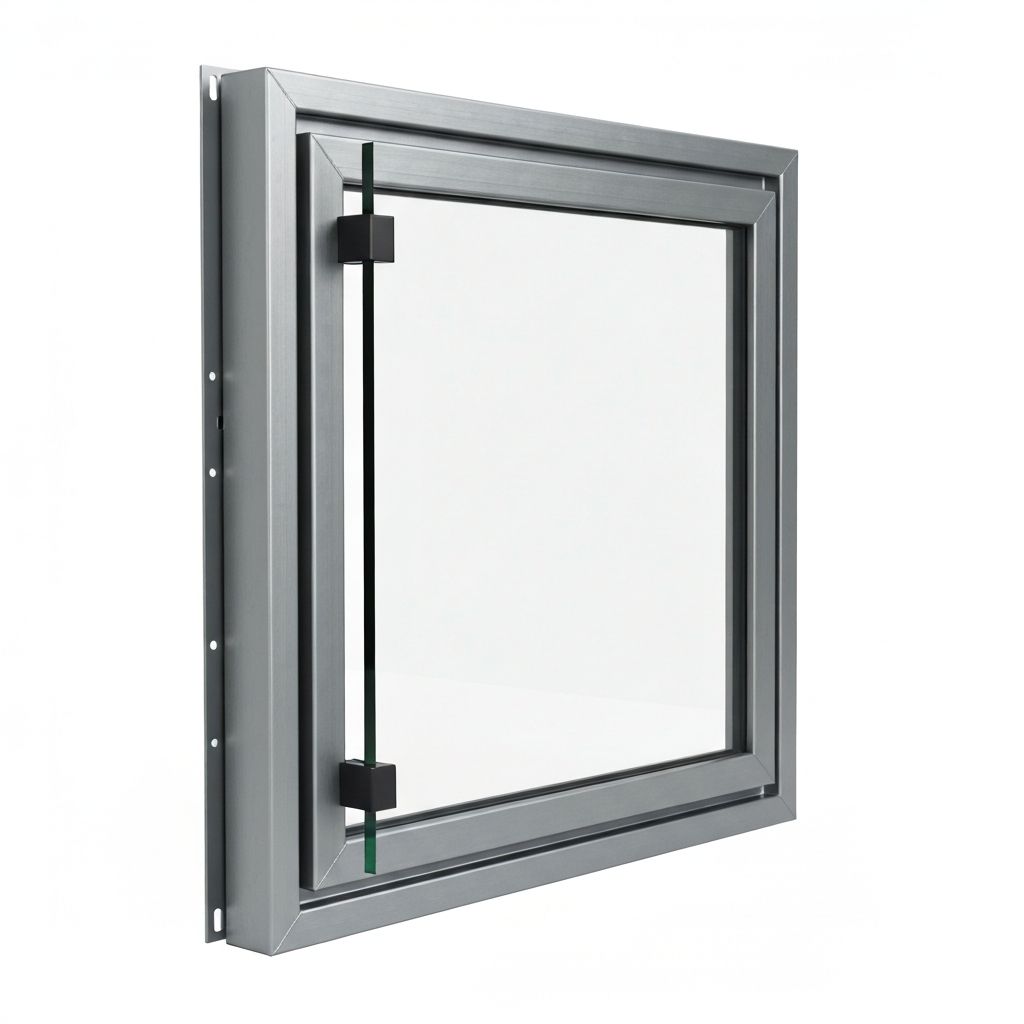
A glazing system is only as strong as its perimeter. This principle holds doubly true under fire exposure. Glass that achieves 90 minutes of integrity in a laboratory test can fail in 20 minutes inside a poorly designed frame.
The frame doesn't just hold the glass—it defines:
- The thermal expansion boundary conditions
- The sealing plane geometry
- The structural load path when steel begins losing strength at elevated temperatures
The relevant testing standard in China—GB 16809-2008—explicitly states that the window frame must possess sufficient strength to guarantee the integrity and stability of the entire assembly during fire exposure.
3. Cold-Rolled Steel: What Makes It the Standard
Among the material options available for fire-rated window frames—aluminum, timber, various steel grades—cold-rolled steel has emerged as the dominant choice for performance-oriented applications.
Why Cold-Rolled Steel?
- Higher dimensional accuracy compared to hot-rolled sections
- The tolerance between frame and glass directly affects intumescent seal performance
- Better surface finish for consistent seal engagement
Fire Rating Grades Under Chinese Standards
| Fire Rating Grade | Minimum Integrity Duration | Typical Frame Wall Thickness |
|---|---|---|
| Grade A (甲级) | ≥1.2 hours | ≥1.5 mm cold-rolled steel |
| Grade B (乙级) | ≥0.9 hours | ≥1.2 mm cold-rolled steel |
| Grade C (丙级) | ≥0.6 hours | ≥1.0 mm cold-rolled steel |
Frame cavity fill material also plays a critical role. Steel fire window frames must be packed with non-combustible material inside the hollow sections—typically mineral wool, calcium silicate board, or similar—to prevent heat transfer through the frame profile.
4. Fire-Rated Glass: Breaking Down the Categories
The field of fire-rated glass configuration has evolved substantially. A couple of decades ago, wired glass was essentially the only option. Today, the selection includes:
- Wired glass
- Ceramic glass
- Specially tempered glass
- Gel-filled multi-laminate glass
- Borosilicate glass
Chinese National Standard GB 15763.1-2009 Classifications
| Class | Type | Performance |
|---|---|---|
| Class A | Insulating Fire Glass | Satisfies both fire integrity AND fire insulation requirements |
| Class B | Partially Insulating | Integrity plus partial thermal radiation shielding |
| Class C | Non-Insulating Fire Glass | Satisfies fire integrity requirements only |
Glass Type Comparison
| Glass Type | Fire Resistance Duration | Insulating? | Key Limitations |
|---|---|---|---|
| Wired Glass | 20–45 minutes | No (integrity only) | Prone to breakage, wired mesh weakens glass |
| Ceramic Glass | 60–120 minutes | No | Premium cost, no heat insulation |
| Tempered Fire Glass | ~20 minutes | No | Fails hose stream test, limited rating |
| Gel-Filled Multi-Laminate | 60–120 minutes | Yes (foam expansion) | Greater thickness, more complex glazing |
| Borosilicate Glass | >120 minutes | No | High cost, limited availability |
Ceramic glass is notable for its thermal shock resistance—it can handle temperature changes up to 425°C and fire ratings up to 180 minutes. Borosilicate glass shows higher viscosity at elevated temperatures, providing reliable performance above 1,000°C.
5. Matching Glass to the Real Performance Requirement
Glass selection isn't just about picking the highest rating. Cost, weight, visibility, and thermal insulation requirements all factor into the specification decision.
Fire-Rated Glass Performance Matrix
| Application | Recommended Glass Type | Typical Rating | Insulation Required |
|---|---|---|---|
| Interior office partition | Ceramic | 60 min | No |
| Stairwell vision panel | Gel-Filled Multi-Laminate | 90 min | Yes |
| External façade spandrel | Ceramic or Borosilicate | 60–90 min | No (if setback ≥1.2 m) |
| Escape corridor sidelite | Gel-Filled Multi-Laminate | 120 min | Yes |
| Fire door vision panel (<0.5 m²) | Ceramic or Wired | 45–60 min | No |
For escape corridors and stairwells where people may be moving past the window during evacuation, insulating glass becomes important not just for code compliance but for real-world survivability. The radiated heat passing through a non-insulating glass can exceed 10 kW/m² at close distances—enough to cause severe burns and prevent passage—even though the glass itself remains intact.
6. Thermal Release: The Mechanism That Activates When Nobody Is There
A fire window that stays open during a fire is not a fire window—it's a hole in the compartmentation.
Thermal release devices for fire windows solve this problem. The principle is straightforward: under normal conditions, the device holds the window sash in an open position (typically 0–90 degrees). When ambient temperature reaches a predetermined threshold, the heat-sensitive element activates, releasing the holding mechanism and allowing the sash to close automatically.
Key Technical Parameters
| Parameter | Typical Specification |
|---|---|
| Trigger temperature | 68±5°C (standard for most building applications) |
| Temperature range (industrial) | 57°C to 260°C |
| Response time (RTI) | Approximately 105 ms |
| Closing torque | 30 N·m (sufficient for standard-sized steel fire windows) |
| Power requirement (electro-thermal hybrids) | Momentary 24V DC, ~0.7A for <1 second |
Four Functional Modes in Modern Thermal Release Devices
- Manual release
- Thermal (fusible) release via glass bulb or fusible alloy link
- Electric release via fire alarm signal
- Feedback signaling to indicate window status (open/closed) at the control panel
The relevant Chinese standard—GB 16809-2008, Clause 3.5—explicitly requires that operable fire windows be equipped with control devices capable of automatic closure activated by heat-sensitive elements such as fusible alloy links or glass bulbs.
7. How a Fire Window Manufacturer Puts the System Together
A fire door and window manufacturer doesn't just fabricate individual components. The core competency lies in system integration—bringing together the steel frame, the fire-rated glass, the intumescent seals, the thermal release device, and the hardware into an assembly that performs as a single fire-rated system.
The Structured Sequence
-
Frame fabrication: Cold-rolled steel is roll-formed or press-braked into profiles, cut to length, welded or mechanically joined at corners, and filled with non-combustible core material
-
Surface treatment: Frames receive corrosion protection (typically zinc-rich primer or hot-dip galvanizing) followed by powder coating
-
Glass installation: The specified fire-rated glass is seated into the frame rebate with appropriate setting blocks, gaskets, and intumescent glazing seals. Glass-to-frame clearance must be maintained within ±1 mm
-
Hardware and thermal release mounting: Hinges, latches, closers, and thermal release devices are mounted and adjusted
-
Factory pre-testing: Many manufacturers conduct in-house fire testing on representative specimens before submitting to accredited third-party laboratories
8. Quality Control That Goes Beyond Paperwork
For a fire door and window manufacturer delivering certified products, quality control operates on a different logic than conventional window production.
The component with the lowest fire performance determines the rating of the entire assembly. This "weakest-link rule" governs every QC decision.
A manufacturer cannot test a frame with one glass type and assume the rating holds with a different glass. The same applies to hardware substitutions. A thermal release device rated for 68°C activation cannot be replaced with a similar-looking unit unless its fire performance has been verified within the system context.
Required Certifications
- ISO 9001 for underlying quality management
- CCC fire protection product certification (China)
- BS 476-22 (UK)
- EN 1634-1 (EU)
- UL 10C / NFPA 252 (US)
Incoming Material Inspection Covers
- Steel coil thickness verification against mill certificates
- Glass fire rating and dimensional tolerance checks
- Intumescent seal expansion ratio testing at specified temperatures
- Thermal release bulb activation temperature calibration
- Hardware fire rating documentation review
Conclusion
Fire window design is system engineering. The frame, the glass, the seals, and the thermal release mechanism must all work together under conditions that nobody wants to experience but everybody must prepare for.
For specifiers and procurement teams, the key questions remain consistent:
- Has the complete assembly been tested to the applicable standard?
- Does the manufacturer control the critical interfaces between components?
- Is there traceability from raw material to finished product?
- What ongoing quality surveillance is in place?
The market data shows where investment is flowing. The technical requirements show what that investment must deliver. And for manufacturers who understand both, the opportunity is substantial—but only if the engineering matches the promise.