1. What "Premium Fire Shutter" Actually Demands
If you have ever looked at a specification calling for a premium fire shutter product, you probably noticed something. The spec doesn't just say "4-hour fire rated." It calls out things like back-face temperature rise limits, material thicknesses, descent speed tolerances, and control system fail-over protocols. These details are the difference between a door that holds back flames and a door that genuinely protects what is on the other side.
A lot of people outside the industry assume a fire shutter is a heavy piece of steel on a motorised drum. That assumption is about fifteen years out of date.
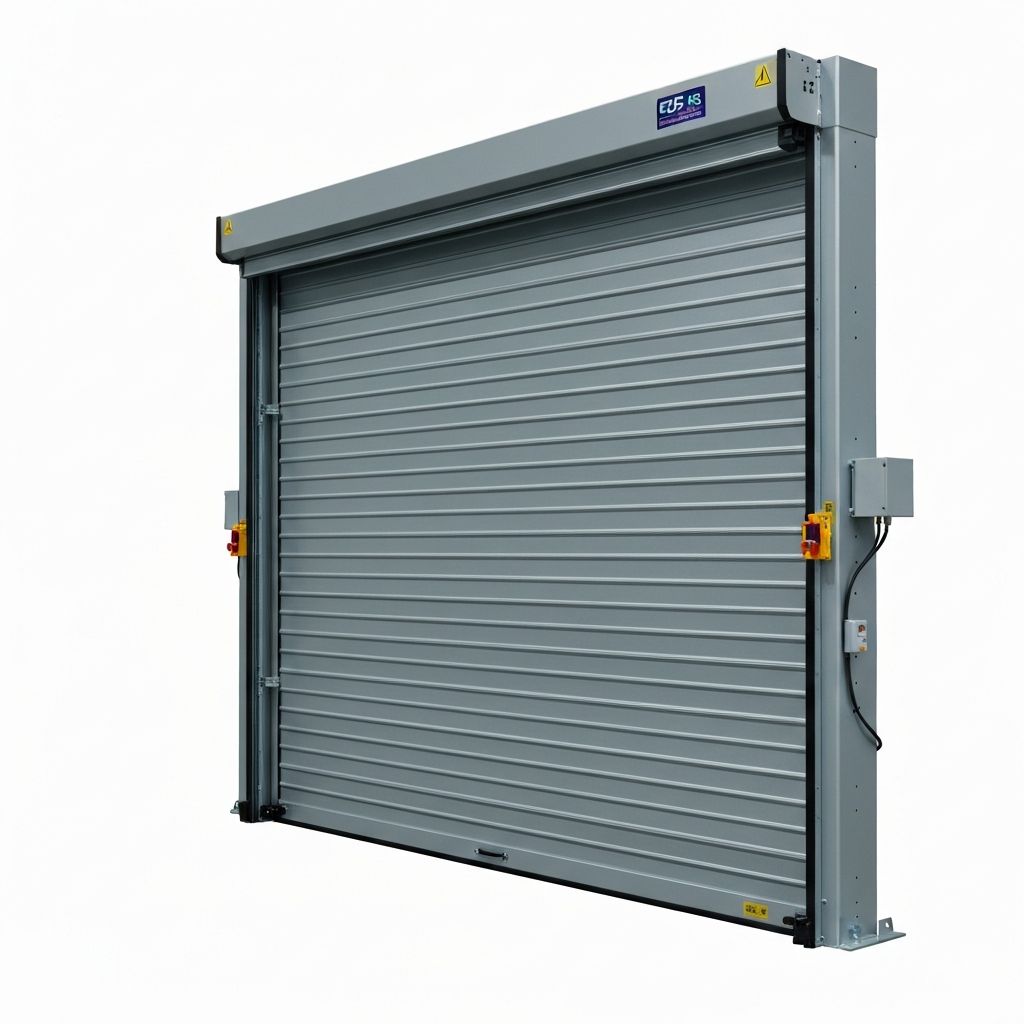
A proper premium fire shutter is a system: fire shutter curtain material, barrel and guides, counterbalance mechanism, motor, control logic, smoke detection, battery backup, and often integration with the building's fire alarm panel. Mess up one of those elements and the rating on the label means nothing. The term fire shutter control system covers more than a motor and a switch; it covers the entire chain of detection, decision, and actuation that has to work when mains power is gone and the room is filling with smoke.
2. The Curtain Face Material Decision Tree
The curtain face is the primary fire barrier. It sits rolled up inside the head box, sometimes for years, and must deploy reliably when a fusible link reaches its melting temperature or a smoke detector trips. It must hold its structural integrity while one side is exposed to temperatures exceeding 1,000°C and the other side must not transmit enough heat to ignite materials in the adjacent compartment.
Fire shutter curtain material selection follows a decision tree that starts with one question: does the opening require insulation or integrity only?
- Integrity-only rated shutters stop flame and hot gases from passing through but permit heat radiation into the adjacent space.
- Insulation-rated shutters additionally limit the temperature rise on the unexposed face, typically below 140°C as an average and under 180°C at any single measurement point—criteria that come directly from testing standards like GB 14102 and EN 1634-1.
This distinction drives the entire material choice.
3. From Cold-Rolled Steel to Inorganic Fiber: A Deep Dive Into Curtain Fabrics
Let me break down the main material families, because the performance profiles are very different and the wrong choice is expensive.
Cold-Rolled Galvanized Steel Slat Curtains
This is the workhorse. Interlocking slats formed from galvanized steel sheet, often 0.8–1.5 mm thick, provide a dense, robust barrier. These systems deliver strong radiant heat resistance, high mechanical durability, and a clean industrial aesthetic. The limitation is heat conduction: steel is thermally conductive, so unless the slat cavity is filled with insulation material, the unexposed face temperature will rise beyond what an insulation classification allows.
Inorganic Fiber Composite Curtains
This is where premium fire shutter curtain material technology has moved the fastest. The industry now uses woven fabrics based on aluminosilicate (ceramic fiber) yarns reinforced with nickel-chromium stainless steel wire, with a grammage typically between 500 g/m² and 1,200 g/m². The fabric is stitched using Kevlar or stainless steel thread and hemmed to create a flexible barrier that rolls onto a compact barrel.
These curtains can withstand continuous exposure temperatures of around 1,100°C while the steel wire skeleton holds the fabric together even after the carrier polymer burns away. Some variants incorporate an intumescent coating that expands when heated, closing pinholes and stitching perforations to enhance smoke tightness.
Hybrid and Composite Systems
A growing segment combines a steel slat face with a fiber insulation blanket bonded to the back, forming a sandwich construction that achieves both structural robustness and thermal insulation. These are heavier, require larger barrel diameters, and need more space in the head box. They are typically specified for fire walls and compartment boundaries where the "4-hour insulation" classification is mandatory.
Stainless Steel Variants
For corrosive environments (wastewater treatment plants, coastal facilities, chemical processing areas), stainless steel slat curtains are specified. Grade 304 is standard; grade 316 is used where chloride exposure is present. The material cost differential versus galvanized steel is typically a factor of 2 to 3, but the lifecycle cost can be lower in the right environment.
4. The Control System Nobody Thinks About Until the Alarm Sounds
The fire shutter control system is arguably the most under-appreciated element of the entire assembly. Most people never see it operate. When they do, there is a fire.
The control system has to solve a surprisingly complex set of problems:
- Detection: Detect a fire event through at least two independent pathways (typically smoke detectors and fusible links)
- Power backup: Initiate descent without relying on mains power—hence the battery backup requirement, which under many codes must supply at least 30 minutes of standby capability
- Speed control: Control descent speed within a defined range to avoid injury and door damage while closing quickly enough to contain the fire
- Communication: Communicate status back to the building's fire alarm panel so that the fire command center knows which openings are closed and which are still open
A well-engineered control panel handles all of this. Features that appear in premium systems include:
- Automatic motor end-limit detection
- Selectable driven or gravity-fail-safe close modes
- Two-stage controlled descent for corridors
- Dedicated inputs for fire alarm volt-free signals, fusible links, and smoke detectors
- Low-battery auto-close feature
- Dedicated fireman's override switch
- Group control modules for synchronizing multiple shutters
5. Testing, Certification, and the Language of Fire Ratings
Fire shutter ratings are not theoretical. They are proven through furnace testing to defined time-temperature curves—most commonly ISO 834 in Europe and ASTM E119 in North America—where the furnace temperature reaches approximately 1,000°C at 60 minutes and continues climbing to over 1,100°C at 120 minutes.
Global Certification Frameworks
| System | Applicable Regions | Key Standard |
|---|---|---|
| EN 16034 | European Union | CE marking mandatory since November 2019 |
| NFPA 80 + UL 10B/C | North America | UL certification required |
| GB 14102 | China | F3 (3 hours) and F4 (4 hours) classifications |
The key distinction in ratings is integrity versus insulation:
- An "E" classification means integrity only—flame and hot gases do not pass through
- An "EI" classification adds insulation—unexposed face temperature rise is limited
A "premium" fire shutter typically carries an EI rating, often at 120- or 240-minute durations.
Third-party certification matters. A label from UL, Intertek, or a notified European certification body means the product has been tested, the manufacturing facility has undergone an initial inspection, and ongoing surveillance audits are in place to verify continued compliance.
6. Material and Rating Comparisons
| Curtain Material Type | Typical Thickness | Max Fire Rating | Insulation Capable | Weight per m² | Typical Application |
|---|---|---|---|---|---|
| Cold-Rolled Galvanized Steel | 0.8–1.5 mm | Up to 4 hours (integrity only) | No | 12–18 kg | Industrial, warehouse |
| Stainless Steel (304/316) | 0.8–1.5 mm | Up to 4 hours (integrity only) | No | 12–18 kg | Corrosive, food-grade |
| Steel Composite (slat + fiber) | 1.2 mm + ≥20 mm blanket | Up to 4 hours | Yes (≤140°C avg) | 20–30 kg | Fire walls, compartments |
| Inorganic Fiber Fabric | 500–1,200 g/m² | Up to 3 hours | Yes (limited) | 5–10 kg | Atria, theaters, aesthetic |
Sources: Compiled from GB 14102, EN 1634-1, and published product documentation.
7. What Separates a Real Manufacturer From a Distributor With a Catalog
There are hundreds of companies selling rated fire shutters. Far fewer actually design, test, and manufacture the complete system.
A genuine fire doors and windows manufacturer operating in this space typically:
- Holds ISO 9001 certification as a baseline
- Maintains an in-house furnace for development testing
- Fabricates curtain material in-house or sources from a qualified supplier with full material traceability
- Has qualified welding procedures
- Controls galvanizing and coating processes
- Manufactures or sources motors and control panels from established suppliers with documented compatibility testing
Warning Signs of a Distributor (Not a Manufacturer)
- Inability to provide a Declaration of Performance (DoP) under EN 16034
- No notified body factory production control certificate
- Limited or no in-house test data beyond the initial certification test
- Reliance on third-party sourcing without documented incoming inspection protocols
- Inability to produce batch-traceable material certificates
8. Market Trajectory and Why Specifiers Are Tightening Requirements
The global fire door market was estimated at approximately USD 16.7 billion in 2024 and is projected to reach around USD 19.9 billion by 2030, growing at a compound annual rate of about 2.9%.
Regulatory pressure is pushing in one direction: toward stricter certification. The extension of CE marking requirements to all fire shutters under EN 16034 has consolidated the European market and raised the barrier to entry for uncertified imports.
In China, the evolution from GB 14102-2005 to the newer GB 14102.1-2024 framework further clarifies testing requirements, terminology, and classification, bringing the domestic market closer to international norms.
9. Conclusion: The Whole System, Not Just a Curtain Face
A premium fire shutter is not a commodity product. It is an engineered opening protective that has to perform exactly once—and exactly right—when everything else in the building is going wrong.
When writing specifications or evaluating supplier proposals:
- Ask for the test report, not just the data sheet
- Confirm the certification body that issued it
- Check control system documentation for battery autonomy, descent speed, and fail-over logic
- Verify curtain material traceability extends back to the coil or fabric lot
A fire shutter is a promise. The materials, the controls, and the testing behind it are what make that promise credible.